Wednesday, July 22, 2020

GENETICS 7

SICKLE-CELL ANAEMIA

  • Autosome linked recessive trait
  • It can be transmitted from parents to the offspring when both the parents are carrier for the gene.
  • Disease is controlled by a single pair of allele, HbA and HbS.
  • HbHbS homozygous shows the diseased phenotype.

  • Heterozygous individuals HbA HbS show normal phenotype but they are carrier of the disease.

  • The defect is caused due to substitution of Glutamic acid (Glu) by Valine (Val) at the sixth position of the beta globin chain of the haemoglobin molecule. It results from single base substitution from GAG to GUG at sixth codon of the beta globin.
  • Due to this, mutant haemoglobin is formed. It undergoes polymerization under low oxygen tension causing the change in the shape of the RBCs from biconcave to elongated sickle-like.

PHENYLKETONURIA

  • Inborn error of metabolism
  • autosomal recessive trait.
  • Affected individual lacks an enzyme that converts the amino acid phenylalanine into tyrosine.
  • Due to which, phenylalanine gets accumulated and converted into phenylpyruvic acid and other derivatives.
  • This causes mental retardation

GENETICS 6

MUTATION

  • Mutation is any change in DNA sequence.
  • It is a heritable change.
  • Mutations can affect genotype as well as phenotype.
  • It also leads to variations.
  • Types of mutations:
  • 1. Gene mutation--  Point mutations, frame-shift mutations
  • 2. Chromosomal mutation- change in no. Or change in structure.

Gene mutation
   A. ReplacementMutations that occur due to change in a single base pair of DNA is called as point mutations.
 For example: sickle cell anemia

 
  • When there is deletion or insertion of base pairs of DNA, it causes frame-shift mutations.

  • Mutagens are the chemical and physical factors that induce mutations. UV rays can also cause mutations.


GENETIC DISORDERS

  • Analysis of traits in several generations of family is called pedigree analysis.
  • Inheritance of a particular trait is represented in the family tree over generations.
  • Symbols used in pedigree analysis

GENETIC DISORDERS
Two types
1. Mendelian
2. Chromosomal

MENDELIAN DISORDERS

  • Occurs due to single gene changes

Follow the inheritance pattern suggested by mendal

Can be Dominant or Recessive

Can be autosomal or sex linked.

Inheritance pattern can be traced in a family by pedigree analysis

  • Autosomal disorders – cystic fibrosis, sickle cell anaemia, myotonic dystrophy
  • Sex-linked – haemophilia, colour blindness

  • HAEMOPHILIA – 
  • sex-linked recessive disease
  • A single protein that is a part of the cascade of proteins involved in the clotting of blood is affected.
  • In affected individual, a simple cut will result in non-stop bleeding.
  • Heterozygous female (carrier) can transmit the disease to son.
  • Possibility of female becoming a haemophilic is extremely rare.


COLOUR BLINDNESS
sex linked
Recessive

GENETICS 5

LINKAGE AND RECOMBINATION

  • Morgan carried out several dihybrid crosses in Drosophila melanogaster to study genes that were sex-linked - discovered variation
  • Why drosophila (fruitfly)--
  • 1. Can be grown in simple medium
  • 2. Male female easily distinguishable
  • 3. Short life cycle
  • 4. Produce large no of progeny
  • 5. Various features can be seen with low power microscope.

  • Morgan hybridized yellow-bodied, white-eyed females to brown-bodied, red-eyed males and intercrossed those F1

  • According to him, two genes did not segregate independent of each other and F2 ratio deviated from 9:3:3:1. 

  • This concluded that genes are linked. When they are located on same chromosome. This process is called linkage.
  • This forms more parental combinations.

  • Some pair are tightly linked - very less recombination
  • Some are loosely linked- show slight more recombination

  • Recombination is the rearrangement of genetic material. The generation of non-parental gene combination during dihybrid cross is called recombination. 
  • When genes are located on same chromosome, they are tightly linked and show less linkage. This is responsible for variation.

Linkage depends on distance between genes on chromosome- helps in genetic mapping

Genetic mapping- knowing the location of various genes in our genome.

Used in HGP human genome project


SEX DETERMINATION

  • Different organisms have different types of sex determination.
  • Cytological observations in insects -- genetic or chromosomal basis of sex-determination.
  • In 1891, Henking traced a specific nuclear structure all through spermatogenesis in few insects.
  • He observed specific nuclear structure is located on 50 per cent of sperms only. The discovered X-body but was unable to explain its significance.
  • Later- X body - X chromosome

  • In insects
  • XO type of sex determination is present. 
  • All the eggs have an additional X-chromosome besides the autosomes. Some sperms bear X-chromosome where as some do not.
  • Eggs fertilized by sperm having having X-chromosome become females and those fertilized by sperms that do not have an X-chromosome becomes males.
  • For example: grasshopper (males have only one X-chromosome besides autosomes and females have a pair of X-chromosomes)

Found, X chromosome only, helps in sex determination- sex chromosome
Others- autosome

SEX DETERMINATION IN HUMANS

  • XY type of sex determination
  • Males (XY), Females (XX)
  • Drosophila also has XY type of sex determination.

So till here, male forms 2 different gametes, so male- heterogametic
Female- homogametic


SEX DETERMINATION IN BIRDS

  • ZW type of sex determination is seen in birds.
  • Females have ZW and males have ZZ chromosomes.
  • In birds sex is determined by type of ovum.
  • In birds, females are heterogametic

SEX DETERMINATION IN HUMAN


SEX DETERMINATION IN BEES


GENETICS 4

TEST CROSS
To test whether homozygous or hetero..

Unknown genotype offspring × recessive parent

If heterozygous, result is 1:1

DIHYBRID CROSS

Mendel also worked with two characters on pea plant. He chose color and shape of the seed to explain the inheritance of two genes.

Y – dominant yellow color

y – recessive green color

R – round shape of the seed

r – wrinkled shape of the seed


Phenotypic Ratio:

Round yellow : round green : wrinkled yellow : wrinkled green

        9  :   3    :    3    :   1

So, monohybrid ratio phenotype ratio 3:1 is followed in dihybrid cross also.

Both colour 3:1

Shape 3:1 


LAW OF INDEPENDENT ASSORTMENT

Segregate and then inheritated seperately

So, equal chance for each gamete to carry an allele, and then express itself in offspring.


CHROMOSOMAL THEORY OF INHERITANCE

  • Mendel published his work on inheritance of characters in 1865 but was unrecognized till 1900.
Why remain unrecognised?
1. Lack of communication, not published widely
2. Mendal- 1 gene- controls - 1 character
     1gene- 2 alleles- 2 different character
     Which do not blend with each other
   So, unacceptable.
3. Mathematics and statistics
4. Lack of proof, (regarding factor/gene)

  • In 1900, de Vries, Correns and von Tschermak worked independently and rediscovered Mendel’s results.

Imp reason of Rediscovery-- microscopy- cell division- chromosomes 

  • In 1902, Walter Sutton and Theodore Boveri studied the chromosomal movement during meiosis.
  • They observed- behaviour of chromosome is like the behaviour of mendal factors.
  • According to this theory, (combination of these 2)

  1. Genes are located at specific locations on the chromosomes.
  2. Chromosomes as well as gene both occur in pairs.
  3. Homologous chromosomes + genes separate during meiosis.
  4. Fertilization restores chromosome number to diploid condition.
  5. Chromosomes + genes segregate as well as assort independently.

Saturday, July 18, 2020

GENETICS 3

LAW OF DOMINANCE

The dominant allele masks the effect of recessive allele. 

It explains the expression of only one of the parental characters in a monohybrid cross in F1 and expression of both in F2.


  • In a dissimilar pair of factors one member of pair dominate the other. For example: allele of tallness (T) is dominant over allele of dwarf (t).

LAW OF SEGREGATION

It states that every individual possess two alleles of a gene and these alleles segregate from each other during gamete formation (at the time of meiosis). Alleles do not blend and both the characters are recovered during gamete formation in F2 generation.

Homozygous individuals produce one type of gametes while heterozygous individuals produce two types of gametes each having one allele with equal proportion.


INCOMPLETE DOMINANCE

When the experiments were repeated on other traits on other plants, sometimes it was found that F1 progeny does not resemble either of the parent, it was a mixture of two.

For example: Snapdragon or Antirrhinum sp. or dog flower – inheritance of flower color.


Genotypic ratio was same as we would expect in Mendelian monohybrid cross but phenotypic ratio is changed.


CO-DOMINANCE

The two alleles are able to express themselves independently when present together.

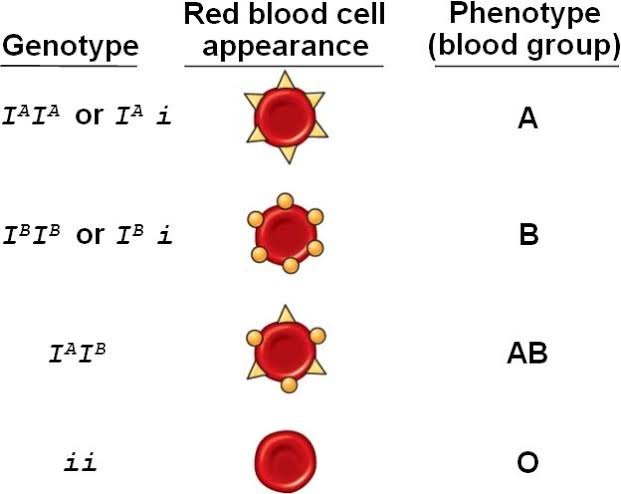
For example: ABO blood grouping in humans is controlled by gene I. It has three alleles IA, IB and i.

IA, IB are dominant over i. If IA and I are present, only IA expresses. IA and IB are present both of them express each other.

ABO blood grouping is also a good example of multiple alleles.


Friday, July 17, 2020

GENETICS 2

INHERITANCE OF ONE GENE (MONOHYBRID CROSS)

Mendel crossed tall and dwarf pea plant and collected the seeds from them.

Seeds were used to generate plants of first generation (F1 or Filial progeny). 

Mendel observed that all the first generation plants were tall, none of them were dwarf.


He made similar observations for the other pairs of traits.


 Conclusion- F1 generation resembled either one of the parents

2nd generation(f2 generation) -- He then self-pollinated the tall F1 plants -- Out of all, ¼th were dwarf and 3/4th were tall.


Similar results were obtained for other traits too. 


In F2 generation, both the traits were expressed in proportion of 3:1. 

Dominant trait in F2 is about thrice of the recessive from. 

These contrasting traits did not show any blending at either F1 or F2 stage.


conclusion -- something was being stably passed from one generation to the other. He named it ‘factors’ which are now called as ‘genes’.

Gene is the unit of inheritance.

 It contains information that is required to express a particular trait in an organism. 

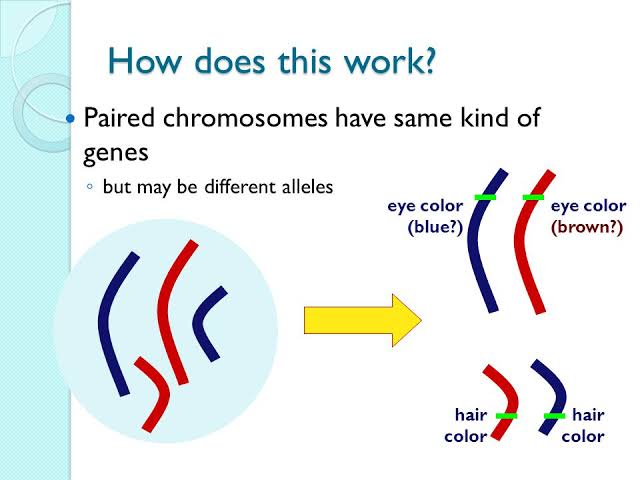
Genes which code for a pair of contrasting traits are known as ‘alleles’. They are slightly different for a same gene.


For representing traits using alphabetical symbols, capital letter is used for the trait expressed at F1 generation  and small letter is used for the other one.

For example: T for tall trait

t for dwarf.

T and t are alleles of each other. Pair of alleles for height in the plants are TT, Tt and tt.

TT and tt are homozygous.

 TT and tt are called genotype of the plant while the description terms tall and dwarf are phenotype

Genotype- gene composition (allele coposition)

Phenotype- physical character/ appearance.

Tt represents heterozygous.


Punnett squares

The production of gametes by the parents, formation of zygotes can be easily understood by Punnett square.

 It was given by British geneticist RC Punnett. 

It is a graphical representation used to calculate probability of all possible genotypes of offspring in a genetic cross

It is typically used for monohybrid cross conducted by Mendel between true-breeding tall plants and true-breeding dwarf plants