Wednesday, August 19, 2020

MOLECULAR GENETICS 12

 Regulation of gene expression

Gene expression results in the formation of a polypeptide and it can be regulated at several levels such as

  • transcriptional level (formation of primary transcript),
  • processing level (regulation of splicing),
  • transport of mRNA from nucleus to the cytoplasm,
  • translational level.

 In prokaryotes, control of the rate of transcriptional initiation is the predominant site for control of gene expression.

In a transcription unit, the activity of RNA polymerase at a given promoter is in turn regulated by interaction with accessory proteins which can act both positively (activators) and negatively (repressors)

Regulation of gene expression can be studied with the help of Lac operon.

Lac operon

  • Lac refers to lactose in lac operon.


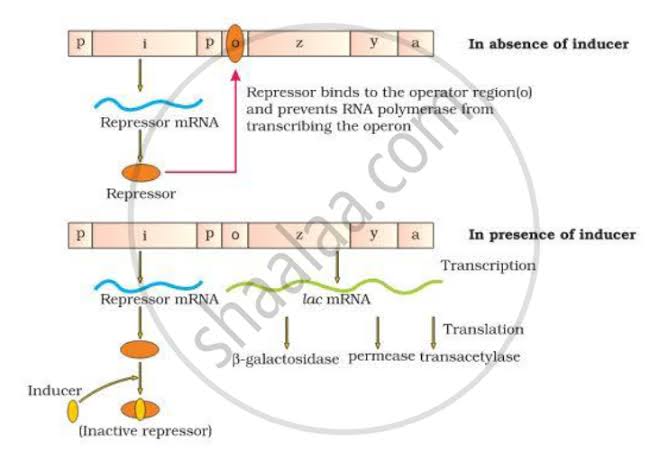
  • The lac operon consists of one regulatory gene the i gene which codes for the repressor of the lac operon and three structural genes (z, y, and a)

  • The z gene codes for beta-galactosidase (β-gal), which hydrolyses disaccharide, lactose into galactose and glucose.
  • The y gene codes for permease, which increases permeability of the cell to β-galactosides.
  • The a gene encodes a transacetylase.
Add caption

  • Lactose is termed as inducer as lactose is the substrate for the enzyme beta-galactosidase and it regulates switching on and off of the operon.

  • In the absence of inducer
  • The repressor of the operon is synthesized (all-the-time – constitutively) from the i gene.
  • The repressor protein binds to the operator region of the operon and prevents RNA polymerase from transcribing the operon.

  • In the presence of inducer
  • The repressor is inactivated by interaction with the inducer which allows RNA polymerase access to the promoter and transcription proceeds.

  • Regulation of lac operon by repressor is referred to as negative regulation.

Positive regulation
Tryptophan operon


Saturday, August 15, 2020

MOLECULAR GENETICS 11

 Translation

  • Translation refers to the process of polymerization of amino acids to form a polypeptide.

  • The order and sequence of amino acids are defined by the sequence of bases in the mRNA and the amino acids are joined by a bond which is known as a peptide bond.

  • Formation of a peptide bond requires energy and thus amino acids are activated in the presence of ATP and linked to their cognate tRNA by the process of charging of tRNA or aminoacylation of tRNA.

  • If charged tRNAs are brought close enough, a peptide bond forms which is enhanced by the presence of a catalyst such as ribosome.

  • Ribosome in its inactive state exists as two subunits; a large subunit and a small subunit.

  • There are two sites in the large subunit, for subsequent amino acids to bind to and thus become close enough to each other for the formation of a peptide bond.

  • A translational unit in mRNA is the sequence of RNA that is flanked by the start codon (AUG) and the stop codon and codes for a polypeptide.

  • An mRNA also has some additional sequences that are not translated and are referred as untranslated regions (UTR).

  • The UTRs are present at both 5'-end (before start codon) and at 3'-end (after stop codon) which are required for efficient translation process.

  • After activation of amino acids, translation starts with its three steps-
  • Initiation
  • Elongation
  • Termination


  • Initiation-
  • For initiation, the ribosome binds to the mRNA at the start codon (AUG) that is recognised only by the initiator tRNA.

  • Elongation-
    • During elongation stage, complexes composed of an amino acid linked to tRNA, sequentially bind to the appropriate codon in mRNA by forming complementary base pairs with the tRNA anticodon.

    • The ribosome moves from codon to codon along the mRNA.


    • Amino acids are added one by one, translated into Polypeptide sequences dictated by DNA and represented by mRNA.

  • Termination-
    • At the end, a release factor binds to the stop codon, terminating translation and releasing the complete polypeptide from the ribosome.


Thursday, August 13, 2020

MOLECULAR GENETICS 10

 Process of transcription

In prokaryotes

Transcription takes place in three steps


  • Initiation
  • RNA polymerase binds to promoter and initiates transcription.
  • Initiation factor or sigma (σ) recognizes the promoter of the DNA.
  • Elongation
  • RNA polymerase facilitates opening of the helix and continues elongation.
  • RNA polymerase uses nucleoside triphosphates as substrate and polymerizes in a template depended fashion following the rule of complementarity.
  • Only a short stretch of RNA remains bound to the enzyme.
  • Termination
  • Once the polymerases reaches the terminator region RNA polymerase binds with the termination-factor (ρ) to terminate transcription.
  • The nascent RNA falls off with the RNA polymerase which results in termination of transcription.

  • The transcription and translation can be coupled in bacteria as the mRNA does not require any processing to become active, 
  • Since only exons are there.
  • and also transcription and translation take place in the same compartment

In eukaryotes

  • There are two additional complexities in eukaryotes.
  1. The first complexity is that there are at least three RNA polymerases in the nucleus.
  • The RNA polymerase I transcribes rRNAs (28S, 18S, and 5.8S)
  • The RNA polymerase III is responsible for transcription of tRNA, 5srRNA, and snRNAs (small nuclear RNAs).
  • The RNA polymerase II transcribes precursor of mRNA, the heterogeneous nuclear RNA (hnRNA).

  1. The second complexity is that the primary transcripts contain both the exons and the introns and are non-functional.

  • Primary transcripts are subjected to a process called splicing where the introns are removed and exons are joined in a defined order.

  • hnRNA undergo two additional processing called as capping and tailing.
  • In capping an unusual nucleotide (methyl guanosine triphosphate) is added to the 5'-end of hnRNA.
  • In tailing, adenylate residues (200-300) are added at 3'-end in a template independent manner and the fully processed hnRNA is called mRNA

  • mRNA is transported out of the nucleus for translation.

Significance of complexities

  • The split-gene arrangements represent probably an ancient feature of the genome.
  • The presence of introns is reminiscent of antiquity, and the process of splicing represents the dominance of RNA-world.

Genetic code

  • The sequence of nucleotides on DNA which determines the sequence of amino acids in a polypeptide chain is termed as Genetic code.

  • The process of translation requires transfer of genetic information from a polymer of nucleotides to a polymer of amino acids
  •  but there is no complementarity between nucleotides and amino acids which led to the proposition of a genetic code that could direct the sequence of amino acids during synthesis of proteins.

(Minimum 20 amino acids,
4 bases,
1 bases /codon - only 4 amino acids
2 bases/ codon- combinations- 16 amino acids
So, 3 bases / codon - 64 combinations - easily code 20 proteins) -- means codon - triplet

  • The salient features of genetic code are as follows:

  • The codon is triplet, 61 codons code for amino acids and 3 codons do not code for any amino acids, hence they function as stop codons. (UAG, UAA, UGA)
  • One codon codes for only one amino acid thus it is unambiguous and specific.

  • Some amino acids are coded by more than one codon, hence the code is degenerate.

  • The codon is read in mRNA in a contiguous fashion, there are no punctuations.

  • The code is nearly universal. For example, from bacteria to human UUU would code for Phenylalanine (phe).

  • AUG has dual functions, it codes for Methionine (met) , and it also act as initiator codon.

Mutation and genetic code

  • Point mutation is the insertion or deletion of a single gene in the structural gene.
  • 2 types - missense mutation - wrong amino acid added
  • Nonsense mutation - stop codon is formed so peptide chain stopped here.

Example- point mutation is a change of single base pair in the gene for beta globin chain that results in the change of amino acid residue glutamate to valine, which results into a diseased condition called as sickle cell anaemia.

  • Frame shift mutation is the insertion and deletion of three or its multiple bases which insert or delete one or multiple codon hence one or multiple amino acids, and reading frame remains unaltered from that point onwards.

Example- cystic fibrosis.

MOLECULAR GENETICS 9

 Transcription

  • The process of copying genetic information from one strand of the DNA into RNA is termed as transcription.

  • In transcription only a segment of DNA and only one of the strands is copied into RNA because
  • if both strands act a template, they would code for RNA molecule with different sequences and the sequences of amino acids in the coded protein would be different.
  • the two RNA molecules would be complementary to each other and would form a double stranded RNA which would prevent translation.


Transcription unit

A  transcription unit consists of

  • A Promoter
  • The Structural gene
  • A Terminator


  • The two strands of the DNA in the structural gene of a transcription unit is termed as template strand and coding strand.
  • The strand that has the polarity 3'→5' acts as a template, and is referred as template strand.

  • The other strand which has the polarity (5'→3') is referred as coding strand.
  • The promoter and terminator flank the structural gene in a transcription unit.
  • The promoter is located towards 5'-end (upstream) of the structural gene which provides binding site for RNA polymerase.
  • The terminator is located towards 3'-end (downstream) of the coding strand which defines the end of the process of transcription.

Structure of a gene

  • A gene is defined as the functional unit of inheritance.
  • A gene also referred as a cistron can be defined as a segment of DNA coding for a polypeptide.
  • The structural gene in a transcription unit could be said as monocistronic mostly in eukaryotes or polycistronic mostly in bacteria or prokaryotes.

  • Exons are the coding sequences or expressed sequences that appear in mature or processed RNA.
  • Introns are the intervening sequences which interrupt exons and do not appear in mature or processed RNA.

Types of RNA

  • There are three major types of RNAs
  • mRNA (messenger RNA),
  • tRNA (transfer RNA),
  • rRNA (ribosomal RNA).


  • All three RNAs are needed to synthesize a protein in a cell.
  • The mRNA provides the template, tRNA brings amino acids and reads the genetic code, and rRNAs play structural and catalytic role during translation


Structure of tRNA

  • The tRNA, also called as sRNA (soluble RNA) has a role as an adapter molecule.

  • tRNA has an anticodon loop that has bases complementary to the code.

  • It has an amino acid accepter end to which it binds to amino acids.
  • The secondary structure of tRNA looks like a clover-leaf.
  • In actual structure, the tRNA is compact molecule which looks like inverted L.

rRNA-